
Choosing between WordPress and a custom-built stack is a pivotal decision for an Indian startup in 2026-2027. The right choice doesn’t just impact your initial launch but dictates your agility, burn rate, and technical debt for the next eighteen months.
The WordPress MVP: Speed and Low Friction
In 2026-2027, WordPress has evolved far beyond a blogging platform. For many early-stage startups, it remains the most logical “Minimum Viable Product” (MVP) choice due to its sheer speed of deployment.
The Case for WordPress
- Time-to-Market: You can launch a fully functional, professional-looking corporate site in under two weeks. In the fast-paced startup hubs of Bangalore or Gurgaon, being first to market or first to a funding round is often more valuable than having the “perfect” code.
- Cost Efficiency: For a startup operating on a lean budget, WordPress allows you to allocate more capital toward customer acquisition and product development rather than back-end architecture.
- Ease of Management: Non-technical founders can easily update content, post blogs, and tweak landing pages without waiting for a developer’s sprint cycle.
When to Choose WordPress
If your startup is in a service-oriented industry (like an exhibition agency, consultancy, or simple e-commerce), WordPress is usually sufficient. It handles high-quality imagery, SEO, and lead generation exceptionally well.
The Customized Website: Scalability and IP
A custom-built website (using React, Next.js, or a MERN stack) is a different beast entirely. This route involves building your digital presence from the ground up, providing complete control over every pixel and function.
The Case for Custom Development
- Superior Performance: Custom sites are leaner. Without the “bloat” of general-purpose plugins, they load significantly faster, which is a major ranking factor in 2026 & 2027’s SEO landscape and crucial for users on mobile networks in Tier-2 and Tier-3 cities.
- Unique User Experience: If your MVP requires a unique interactive tool—such as a complex dashboard, a real-time calculator, or a proprietary algorithm—WordPress might feel like trying to fit a square peg in a round hole.
- Investor Perception: For deep-tech or SaaS startups, having a custom-built platform demonstrates technical prowess and creates “Intellectual Property” (IP). Investors often view custom-built MVPs as more “serious” or “scalable.”
When to Choose Custom
If your website is the product (e.g., a SaaS platform, a fintech app, or an AI-driven tool), skip the templates. Build a custom MVP that can scale as your user base grows from 100 to 100,000.
The 2026-2027 Verdict: The Hybrid Strategy
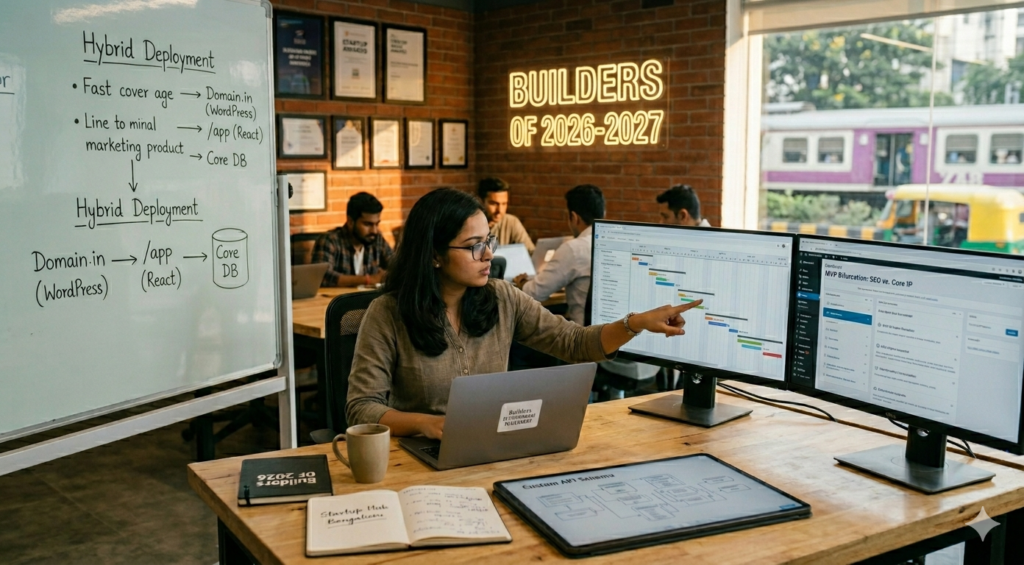
The most successful Indian startups in 2026-2027 are often employing a bifurcated approach. They use WordPress (or Webflow) for their corporate/marketing site to maintain agility in SEO and content marketing, while keeping their core product on a custom-built subdomain (e.g., app.startupname.in).
Comparison Table
| Feature | WordPress MVP | Custom-Built MVP |
| Development Time | 1 – 3 Weeks | 2 – 4 Months |
| Initial Cost | ₹30k – ₹80k | ₹2 Lakhs+ |
| SEO Flexibility | High (via Plugins) | Maximum (Structural) |
| Security | Vulnerable to Plugin Bugs | High (Proprietary) |
| Scalability | Moderate | High |
Final Recommendation
For 2026-2027, if you are an early-stage startup testing a hypothesis, go with WordPress. It allows you to fail fast or pivot cheaply. However, if your business model relies on a proprietary technical process or high-security data handling, the Customized Website is the only way to build a sustainable foundation. Don’t over-engineer your marketing site; save your technical firepower for your core product.